

Democracy Mind is a course that educates on how the way we think and feel shapes the world around us — and how the systems we live in shape the way we think and feel. Once we see this connection clearly, we can start changing both ourselves and our societies from the inside out.
You’ll learn simple, powerful tools for self-awareness, emotional balance, and meaningful connection — and explore how these same skills can support a more caring and fair world. Imagine a culture where people value curiosity over certainty, listening over arguing, and service over self-interest.
*Democracy Mind is an educational program exploring psychology, neuroscience, and world citizenship. It is not a health service or therapy. Participation does not create a client–psychologist relationship, and for Australian participants, the program is not delivered under AHPRA regulations.
Why it matters
Our world is changing fast. Many of the comforts and securities we used to take for granted — housing, stability, trust — are slipping away. Political fixes help, but they’re not enough anymore.
Psychology and neuroscience show that the way we handle our emotions, thoughts, and relationships has a huge impact on the kind of societies we create together.
When we learn to slow down, listen deeply, and stay open — even in disagreement — we make it possible for new kinds of cooperation and creativity to emerge.
This course helps you understand the deeper causes of today’s stress and division, while building the inner strength, calm, and clarity needed to be part of the solution.
At scale, these skills can create communities that are more hopeful, connected, and resilient -- from the local to the global.

Is this course for you?
Democracy Mind is for anyone who wants to grow as a person while contributing to a better world. You don’t need a background in psychology or politics — just an open mind and a willingness to learn.
It’s especially for people who want to:
-
Feel more empowered and hopeful about the future
-
Develop emotional and social intelligence
-
Explore how personal growth connects to global change
-
Learn skills for collaboration, cooperation, empathy, and dialogue
Personal Wellbeing
Practical ways to reduce stress, build healthy relationships, and live with more clarity and confidence.
A Bigger Picture
Understand how your personal growth connects to the wider challenges we face as humanity.
A Sense of Belonging
See yourself not just as a member of a nation -- but as part of one human family sharing one planet.
A New Kind of Politics
Discover how kindness, awareness, and cooperation can form the foundation for a more intelligent and compassionate society.
SESSION 1
Your Engagement in the Evolutionary Process
We begin by clarifying why world citizenship matters now and how political life emerges from inner life. Participants explore their motivations, their role in global evolution, and the link between personal development and collective change.
-
World Citizenship Begins Within — Why the next political shift is also psychological
-
The Inner–Outer Feedback Loop — How minds shape societies, and societies shape minds
-
Evolution as Participation — What it means to consciously contribute to a better world
SESSION 2
Origins & Obstacles of World Citizenship
World citizenship is an ancient idea resurfacing at a pivotal moment.
This session traces its philosophical roots, names the forces preventing planetary unity, and reframes Earth as a shared home for one human family.
-
Ancient Roots, Modern Relevance — From Stoics to cosmopolitanism to human rights
-
Earth as Shared Home — Moving from borders to shared destiny
-
What Holds Us Back — Nationalism, exclusion, inequality, and fear of difference
SESSION 3
How Have Psychology & Politics Come About?
A sweeping look at how human societies organize themselves—and why coherence, symbols, and meaning-making matter to political life.
Participants explore how current systems emerged and what they reveal about our collective psychology.
-
From Polis to Nation-State — What Athens, Rome, and Enlightenment thought set inmotion
-
Order & Dissipation — Why civilizations rise, fragment, and reorganize
-
Symbols & Stories — How imagination stabilizes political worlds
SESSION 4
How Close Are We to World Citizenship?
World citizenship is no longer just philosophy—it exists in law, politics, culture, and economics.
This session examines today’s global structures and asks how close we already are to planetary
democracy.
-
Legal Foundations — Human rights, treaties, and international courts
-
Cosmopolitan Culture — Travel, education, sports, and global media
-
Democratic Imagination — From UN institutions to proposals for world parliament
SESSION 5
How Do We Work? (Psychology & the Mind)
We explore how minds function, develop, and make meaning.
Understanding the mind clarifies why political polarization rises, why coherence is fragile, and why democracy depends on reflective, regulated, symbolic creatures.
-
Mind as Meaning-Maker — From sensation to symbol to cognition
-
Regulation & Coherence — Why safety, reflection, and development matter
-
Politics as Outer Psychology — Societies as mirrors of internal states
SESSION 6
What Would a World Based on World Citizenship Look Like?
If we accepted that all humans are equal and Earth is our shared home, what new institutions, rights, and economic arrangements would emerge?
This session explores the architecture of a democratic planetary future.
-
Planetary Rights & Duties — Equality without exception
-
Institutions for the Whole — World parliament, global voting, open accountability
-
A Shared Civic Imagination — From sovereignty to stewardship
SESSION 7
What’s Wrong With Us? (Psychology Today)
Why are so many people struggling mentally in an era of wealth and opportunity?
We examine the deficiencies of modern psychology, the pressures of modern society, and the social forces
shaping collective unwellness.
-
Medicalization & Pathology — How psychology treats symptoms but not society
-
Unregulated Influences — Marketing, manipulation, and social contagion
-
Collective Stress Response — Survival modes, fear, and political regression
SESSION 8
25 Things You Can Do to Facilitate World Citizenship
World citizenship is not theoretical—it can be practiced.
Participants explore concrete actions in culture, law, education, media, and politics that support planetary democracy and the end of exclusionary citizenship.
-
Practical Pathways — Advocacy, learning, organizing, and influence
-
Citizen Stewardship — Acting as if the world already belongs to everyone
-
Local–Global Link — How small actions accumulate at planetary scale
SESSION 9
Democracy as Evolutionary Destination
Democracy is not simply a system—it reflects a mature form of political psychology.
This session explores why democracy expands, why it is contested, and why a global democratic future aligns with human evolution.
-
The 3 Cs of Politics — Conflict, Collusion, and Collaboration
-
Psychological Preconditions — Empathy, reflection, regulation, and dialogue
-
Democracy as Species-Level Development — Toward equality, plurality, and peace
SESSION 10
Integrating Psychology & Politics in the Modern World
Here we weave together the course’s two strands—inner and outer life.
Participants explore how minds develop, how societies organize, and how both can evolve together toward planetary coherence.
-
Two Maps, One Process — Inner development meets outer governance
-
Regulation to Participation — From self-awareness to civic agency
-
Integration as Strategy — Healing divides within and between nations
SESSION 11
Living a Democracy Mind Life
We conclude by grounding world citizenship in daily life.
Participants refine their personal and collective action plans and identify how to carry forward psychological maturity and planetary belonging.
-
From Insight to Practice — Turning understanding into contribution
-
Cosmopolitan Identity — Belonging to your place and the world at once
-
Ongoing Evolution — Becoming part of humanity’s next political chapter
Course Outline
About this course.
Our Team

Scott Leckie
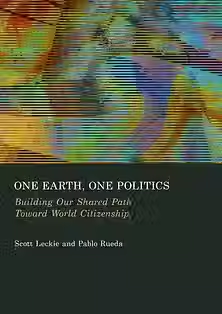
Scott Leckie (BA, LLM) is a globally renowned international human rights advocate and visionary in support of world citizenship and justice. Over four decades, he has worked in more than 80 countries to defend housing, land and property rights for refugees, climate-displaced people and vulnerable communities — influencing UN institutions, international law, and global governance standards. As Founder and Director of Displacement Solutions and of Oneness World Foundation, he has created initiatives such as the One House, One Family project in Bangladesh, building permanent homes for climate-displaced families. Scott has authored 26 books, including One Earth, One Politics: Out Shared Path Toward World Citizenship (with Pablo Rueda) and World Citizenship: Origins, Obstacles, Prospects, and over 300 reports and articles shaping global policy on displacement, human rights and world-citizenship. As a key architect of more than 100 international normative standards — including the “Peninsula Principles on Climate Displacement Within States” — and as advisor to more than 20 UN and inter-governmental agencies, he stands among the leading architects of a more equitable, globally conscious future.

Nigel Denning
Nigel Denning, Counselling Psychologist (MA, MPsych), is the director Integrative Psychology and Medicine, and brings four decades of experience in psychology, human development, and contemplative practice. He has extensive background in individual and group work, professional training, and the development of innovative approaches to attachment, relationships, and non-ordinary states of consciousness. Nigel co-developed Integrative Attachment Therapy with colleagues from Harvard, contributed to international training programs in psychedelic integration, and has participated in research settings exploring non-ordinary states. He has provided education and consultation across areas including institutional abuse, family systems, organisational behaviour, and community dynamics, and has presented at national and international forums on a range of topics related to human behaviour and social influence. Alongside his professional work, Nigel has maintained a 40-year meditation practice within Hindu and Buddhist traditions, and has supported the preservation and teaching of the Tibetan Bon lineage through leadership roles in the Australian Bon Mustang Foundation.

Where we are.
Location
Melbourne, Australia.
Hours
By Appointment.
Let's create change.
© Democracy Mind 2025
Priivacy | Disclaimer